
Learning UX After 40: How to Avoid the "I Need to Know Everything" Trap

Are you considering a career change into UX design after hitting your 40s? Perhaps you’ve been watching the digital landscape evolve and feel drawn to UX DESIGN CAREER TRANSITION as your next professional chapter. Many midlife professionals approach this transition with a mixture of excitement and trepidation, often falling into what I call the “I need to know everything” trap. Let me assure you – this journey is not only possible but can be incredibly rewarding when approached with the right mindset.
The field of UX DESIGN CAREER TRANSITION presents unique opportunities for those with life experience and established professional skills. Your years of working in different environments, managing projects, and understanding human psychology can give you advantages that younger designers might spend years developing. However, the key to success isn’t trying to master every UX tool and methodology before making your move – it’s about leveraging what you already know while strategically building new skills.

Embracing Your Experience: The Hidden Advantage in UX Design Career Transition
One of the greatest assets you bring to a UX DESIGN CAREER TRANSITION is your lived experience. By your 40s, you’ve navigated complex professional environments, collaborated with diverse teams, and likely developed a nuanced understanding of human behavior. These soft skills are invaluable in UX design, where empathy and communication often matter more than technical proficiency with the latest tools.
Consider how your existing skills might transfer to UX design. Were you in customer service? You understand user pain points firsthand. Sales background? You’re already skilled at understanding user needs and motivations. Project management experience? You know how to coordinate multidisciplinary teams – a crucial skill in UX environments. Rather than viewing your career shift as starting from zero, recognize the considerable head start your professional background provides.
Many successful UX designers who transitioned after 40 report that their previous career experiences gave them unique perspectives that their younger colleagues lacked. They brought industry knowledge, problem-solving frameworks, and professional networks that proved invaluable. Your experience isn’t baggage – it’s a competitive advantage in your UX DESIGN CAREER TRANSITION.
Focused Learning: Prioritizing What Really Matters
When approaching a UX DESIGN CAREER TRANSITION, the sheer volume of information available can be overwhelming. From user research methodologies to prototyping tools, design systems to accessibility guidelines – the field is vast. The mistake many midlife career changers make is assuming they need mastery of everything before they can begin.
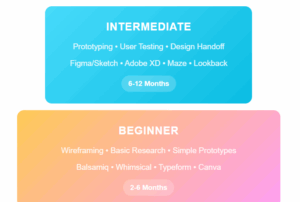
Instead of trying to learn everything at once, identify the core skills that will get you started and focus intensely on those. Begin with understanding UX fundamentals – user research, information architecture, wireframing, and usability principles. Master one prototyping tool rather than dabbling in five. Learn enough about UI to communicate with visual designers, but don’t feel pressured to become an expert illustrator overnight.
Carol, a former marketing manager who made a successful UX DESIGN CAREER TRANSITION at 47, shares: “I initially felt paralyzed by how much I thought I needed to learn. Once I focused just on research methods and basic Figma skills, I was able to create a portfolio piece that demonstrated my thinking process. That was enough to land my first UX role, where I continued learning on the job.”
Building a Strategic Learning Plan

Creating a strategic learning plan is essential for your UX DESIGN CAREER TRANSITION. Unlike younger learners who might have the luxury of immersive full-time study, midlife career changers typically juggle existing responsibilities. Your learning approach needs to be efficient and results-oriented.
Start by defining your specific UX career goal. Do you want to focus on research, or are you more drawn to interaction design? Are you interested in product design for tech companies, or does service design for healthcare appeal to you? Your target role should inform what you prioritize learning.
Next, create a learning roadmap with these components:
- Core UX skills: User research methods, information architecture, wireframing, prototyping, usability testing
- Technical skills: One primary design tool (such as Figma, Sketch, or Adobe XD), basic HTML/CSS understanding
- Soft skills: Presentation techniques, stakeholder management, collaboration methods
- Industry knowledge: Standards and patterns in your target industry
Allocate specific time blocks for learning – perhaps 5-7 hours weekly is realistic alongside your current commitments. Remember that consistent progress trumps sporadic intensive study sessions. Structure this time to include both learning (courses, reading) and doing (practice exercises, portfolio projects).

Leveraging Your Professional Network in Your UX Design Career Transition
Your existing professional network can be an invaluable asset during your UX DESIGN CAREER TRANSITION. After decades in the workforce, you’ve likely built relationships with people across various industries – some of whom may work with UX designers, hire them, or be designers themselves.
Start by mapping your network and identifying potential UX connections. Reach out for informational interviews, explaining your career transition goals. Most professionals are flattered to be asked for advice and willing to share insights about their field. These conversations not only provide practical guidance but may also reveal job opportunities that never get publicly posted.
Consider how your current employer might provide transition opportunities. Could you take on UX-related projects in your current role? Many successful career changers begin by incorporating UX methodologies into their existing position before making a complete transition.
Michael, who transitioned from architecture to UX at 43, explains: “I leveraged my project management experience to get a role coordinating between developers and designers. This gave me exposure to UX processes and terminology while I built my design skills on the side. Within a year, I had moved into a full UX position within the same company.”
Creating a Relevant Portfolio During Your UX Design Career Transition
Perhaps the biggest concern for those pursuing a UX DESIGN CAREER TRANSITION later in life is developing a compelling portfolio without professional UX experience. The good news is that you don’t need to have worked as a UX designer to create effective portfolio pieces.
Focus on quality over quantity – three thoughtful, well-documented projects are more valuable than ten superficial exercises. Your portfolio should showcase your problem-solving process rather than just polished final designs. Prospective employers want to understand how you think, research, iterate, and respond to feedback.
Consider these portfolio project approaches:
- Redesign experiences you find problematic in your daily life, documenting your research and process
- Volunteer your UX skills for non-profits or community organizations
- Create case studies addressing problems in your current industry, leveraging your insider knowledge
- Participate in design challenges that provide real-world problems to solve
Document each step of your process – the problem definition, research methods, key insights, ideation techniques, wireframes, prototypes, testing approaches, and iterations. This comprehensive documentation demonstrates your methodical approach and understanding of UX fundamentals.
Combating Ageism in the UX Industry
While pursuing your UX DESIGN CAREER TRANSITION, you may worry about ageism in the tech industry. While age bias can exist, many companies increasingly value diverse perspectives and life experience on their design teams.
To position yourself effectively:
- Emphasize your adaptability through continuous learning and openness to new technologies
- Highlight transferable skills from your previous career that directly benefit UX work
- Demonstrate your familiarity with current design trends and technologies without trying to appear younger than you are
- Showcase your unique perspective as an advantage – your life experience helps you understand diverse user needs
- Target companies and industries that value experience and maturity
Remember that UX design fundamentally revolves around understanding human needs and behaviors – something your life experience has prepared you well for. Many organizations recognize that diverse design teams, including age diversity, create better products for their diverse user bases.
Joining Communities to Support Your UX Design Career Transition
Don’t make the mistake of pursuing your UX DESIGN CAREER TRANSITION in isolation. Connecting with UX communities can accelerate your learning, provide valuable feedback, and open doors to opportunities.
Look for:
- Local UX meetup groups that welcome beginners
- Online communities like IxDA (Interaction Design Association) or specific UX Slack workspaces
- UX mentorship programs that pair newcomers with experienced designers
- Portfolio review events where you can receive constructive feedback
- UX bootcamp alumni networks if you take a structured course
These communities can provide moral support from others making similar transitions, insider knowledge about job opportunities, feedback on your portfolio work, and guidance when you encounter obstacles.
James, who transitioned to UX at 52 after a career in retail management, shares: “Finding a community of other career-changers was critical to my success. We formed a study group that met weekly to review each other’s work and share resources. This accountability and support system kept me moving forward when things got tough.”
Practical Tips for Daily Progress in Your UX Design Career Transition
Successful UX DESIGN CAREER TRANSITION happens through consistent small steps rather than occasional heroic efforts. Integrate UX learning into your daily routine with these practical approaches:
- Start your day with 20 minutes of reading UX articles or listening to UX podcasts during your commute
- Take a “UX lens” to everyday experiences – analyze how you interact with products and services around you
- Practice sketching interface ideas for common applications you use
- Participate in online UX challenges that provide specific design problems to solve
- Schedule regular portfolio work sessions – even just 90 minutes twice a week adds up significantly
- Follow UX professionals on social media to stay current with industry conversations
- Apply UX thinking to problems in your current role wherever possible
Remember that consistency trumps intensity. Twenty focused minutes daily will yield better results than an occasional eight-hour marathon session that leads to burnout.
Celebrating Small Wins on Your UX Design Career Transition Journey
Transitioning careers is challenging, and it’s easy to focus only on how far you still have to go. Make a conscious effort to acknowledge and celebrate your progress in your UX DESIGN CAREER TRANSITION. Did you complete a tutorial? Receive positive feedback on a design? Make a new industry connection? These are all meaningful steps forward.
Keep a learning journal documenting your growth, challenges, and insights. This record becomes invaluable for recognizing patterns in your learning and identifying areas that energize you. It also provides material you can reference in interviews when discussing your transition journey.
FAQ: Common Questions About UX Design Career Transition After 40
Do I need a design degree to transition to UX design after 40?
No, many successful UX designers don’t have formal design degrees. Focused learning through courses, bootcamps, and self-study, combined with your existing professional experience, can prepare you for UX roles.
How long does it typically take to make a UX design career transition in midlife?
Most midlife career changers report taking between 6-18 months from starting serious learning to landing their first UX role. Your timeline depends on your learning pace, existing transferable skills, networking effectiveness, and time commitment.
Will I need to take an entry-level position, even with decades of professional experience?
Not necessarily. Many midlife career changers leverage their existing professional expertise to enter UX in hybrid or specialized roles that value both UX skills and their industry knowledge.
How do I explain my career change to potential employers?
Focus on the narrative of evolution rather than radical change. Highlight how your previous experience provides valuable perspective for UX work, and demonstrate your commitment to learning through your portfolio projects and continuing education.
Is it worth investing in a UX bootcamp at my age?
For many midlife career changers, the structure and networking opportunities of bootcamps are valuable. Evaluate programs based on their job placement support, portfolio development assistance, and alumni network in your target market.
What questions do you have about transitioning to UX design after 40? Have you started your journey already? Share your experiences or concerns in the comments below – your insights might help others on a similar path!
Posts recentes