

Accelerating UX Research Learning: How Experienced Professionals Can Master UX RESEARCH SKILLS FASTER

In today’s rapidly evolving digital landscape, UX RESEARCH SKILLS have become increasingly valuable across industries. Whether you’re a seasoned designer looking to expand your toolkit or a professional from an adjacent field wanting to transition into user experience, the ability to quickly master UX RESEARCH SKILLS can significantly impact your career trajectory. This comprehensive guide explores how experienced professionals can leverage their existing expertise to accelerate their learning in UX research, bypassing common obstacles and reaching proficiency faster.
The journey to mastering UX RESEARCH SKILLS doesn’t have to be a lengthy process. With the right approach, experienced professionals can capitalize on their transferable skills, establish effective learning frameworks, and implement practical strategies to rapidly develop research competencies. The goal isn’t just to learn quickly but to build a solid foundation of UX RESEARCH SKILLS that can withstand the test of evolving methodologies and industry demands.

Leveraging Your Professional Experience to Enhance UX RESEARCH SKILLS
One of the most powerful advantages experienced professionals bring to the table when learning UX research is their existing knowledge base. Rather than starting from scratch, you can create meaningful connections between what you already know and the UX RESEARCH SKILLS you’re trying to develop.
For professionals with backgrounds in psychology, sociology, or anthropology, the methodological rigor and human-centered approach of these disciplines align perfectly with UX RESEARCH SKILLS. Your understanding of human behavior, cognitive processes, and research methodologies gives you a head start in comprehending user motivations and designing effective research studies.
Those coming from marketing or business analytics backgrounds bring valuable UX RESEARCH SKILLS related to stakeholder management, data analysis, and strategic thinking. Your ability to translate research findings into business impact and communicate effectively with decision-makers positions you to hit the ground running in implementing UX research insights within organizations.
Even professionals from seemingly unrelated fields like engineering or healthcare possess transferable UX RESEARCH SKILLS that can accelerate their learning journey. Problem-solving abilities, attention to detail, and systems thinking are all competencies that translate well to the UX research domain.
The key to leveraging your existing expertise lies in conscious mapping of your current skills to UX research applications. Consider creating a skills inventory that identifies your strengths and aligns them with specific UX RESEARCH SKILLS. This reflective exercise not only builds confidence but also allows you to focus your learning efforts on true knowledge gaps rather than areas where you already have functional competence.
Designing Your Accelerated Learning Roadmap for UX Research
To rapidly develop UX RESEARCH SKILLS, experienced professionals need a structured yet flexible learning approach that addresses their specific needs and learning style. Unlike beginners who might benefit from comprehensive programs covering all basics, you can take a more targeted approach.
Begin by conducting a personal skills gap analysis specifically focused on UX RESEARCH SKILLS. Identify which aspects of UX research align with your current expertise and which areas represent genuine learning opportunities. This assessment forms the foundation of your personalized learning roadmap.
Next, establish clear learning objectives with specific timelines. Rather than setting a vague goal like “learn UX research,” create measurable targets such as “conduct three usability test sessions independently within two months” or “design and implement a complete user interview protocol by the end of the quarter.” These concrete objectives keep your development of UX RESEARCH SKILLS focused and measurable.
Consider adopting a project-based learning approach that allows you to develop multiple UX RESEARCH SKILLS simultaneously within real-world contexts. This might involve volunteering to add UX research components to existing work projects, offering pro bono research services to non-profits, or creating self-directed case studies that address genuine user problems.
To maximize efficiency, employ the concept of skill stacking—combining your existing expertise with new UX RESEARCH SKILLS in unique ways that create distinctive value. For example, a data analyst learning UX research might focus initially on quantitative UX methods, leveraging existing statistical knowledge while gradually expanding into qualitative approaches.
Remember that the fastest path to developing UX RESEARCH SKILLS isn’t always linear. Sometimes strategic detours into adjacent topics can provide valuable context that accelerates overall understanding. For instance, spending time learning about cognitive biases may seem tangential but can dramatically improve your interview techniques and data interpretation abilities.
Immersive Learning Techniques to Fast-Track Your UX Research Expertise

Accelerating the development of your UX RESEARCH SKILLS requires going beyond passive consumption of information. Immersive, hands-on learning experiences create deeper neural connections and facilitate faster skill acquisition through practical application.
One powerful approach is the “learn-apply-reflect” cycle. After learning a specific UX research method or concept, immediately look for opportunities to apply it, even in simplified contexts. Following application, engage in structured reflection to identify what worked, what didn’t, and how to refine your approach next time. This continuous cycle rapidly transforms theoretical knowledge into practical UX RESEARCH SKILLS.
Consider adopting the techniques of deliberate practice to accelerate your learning. Unlike casual practice, deliberate practice involves focused efforts on specific aspects of UX RESEARCH SKILLS that need improvement, immediate feedback, and progressive challenge increases. For example, you might record your user interviews to analyze your questioning techniques, seeking specific feedback from mentors on how to improve your probing questions or reduce leading statements.
Another effective immersion technique is participation in research communities and collaborative projects. Engaging with other practitioners allows you to absorb UX RESEARCH SKILLS through observation, discussion, and shared problem-solving. Look for opportunities to shadow experienced researchers, participate in group analysis sessions, or contribute to open research initiatives where you can learn from peers at various skill levels.
Consider creating simulated research scenarios when real-world opportunities are limited. Design mock research plans, develop interview scripts for hypothetical projects, or analyze existing products using various UX research methods. While not as effective as genuine research experiences, these exercises still help build critical UX RESEARCH SKILLS and establish productive thought patterns.
The immersive approach also benefits from cross-disciplinary exposure. Attend workshops or courses in adjacent fields like behavioral economics, design thinking, or data visualization to develop complementary perspectives that enhance your UX RESEARCH SKILLS and provide unique insights not typically found within standard UX education.

Strategic Networking and Mentorship to Enhance Learning Velocity
The journey to mastering UX RESEARCH SKILLS can be significantly accelerated through strategic connections with the right people. Experienced professionals understand the value of network-based learning and can leverage relationships more effectively than those new to professional development.
Seek out mentorship from practitioners who possess the specific UX RESEARCH SKILLS you aim to develop. Unlike general UX mentorship, targeted guidance from someone specializing in areas like quantitative UX research, research operations, or specialized methodologies can provide shortcuts through complex learning territories. Be specific about what you hope to learn and how the mentor might help you develop particular UX RESEARCH SKILLS.
Consider creating a personal board of advisors—a small group of professionals with complementary expertise who can guide different aspects of your UX research learning journey. This might include a methodologist who helps refine your research design UX RESEARCH SKILLS, a communication expert who enhances your ability to present findings, and an industry insider who provides context on how research functions in specific business environments.
Participation in communities of practice offers another avenue for accelerated learning. Groups like local UX meetups, online forums, or professional associations expose you to diverse perspectives and allow you to absorb UX RESEARCH SKILLS through observation and discussion. These communities also provide safe spaces to ask questions and receive feedback on work in progress.
Don’t underestimate the value of peer learning networks. Forming or joining a group of professionals also developing their UX RESEARCH SKILLS creates mutual accountability and opportunities for collaborative learning. These peer relationships often evolve into long-term professional connections that continue to provide value throughout your career.
When engaging with these networks, position yourself as a contributor rather than just a consumer. Offering insights from your primary expertise while seeking guidance on UX RESEARCH SKILLS creates reciprocal relationships that are more likely to yield substantial learning benefits and open doors to collaboration opportunities.
Overcoming Common Learning Plateaus in UX Research
Even experienced professionals encounter periods where their development of UX RESEARCH SKILLS seems to stall. Recognizing and strategically addressing these plateaus is essential for maintaining momentum in your accelerated learning journey.
The first common plateau occurs during the transition from theoretical understanding to practical application of UX RESEARCH SKILLS. Many professionals can explain research concepts perfectly but struggle when faced with real-world constraints and complexity. To overcome this plateau, create low-stakes opportunities to practice—volunteer for internal projects, offer services to non-profits, or redesign personal experiences—where the consequences of imperfection are minimal but learning potential is high.
Another plateau emerges around synthesis and insight generation. While data collection methods are relatively straightforward to master, the analytical UX RESEARCH SKILLS required to transform data into meaningful insights develop more gradually. Address this by practicing synthesis techniques with existing datasets before generating your own. Study exemplary research reports to understand how experienced researchers structure their findings and connect observations to actionable recommendations.
The stakeholder management plateau affects professionals who have mastered technical UX RESEARCH SKILLS but struggle to navigate organizational dynamics effectively. Learning to frame research in terms of business objectives, manage expectations, and communicate findings persuasively requires deliberate practice in organizational contexts. Seek opportunities to present research findings to different audiences and solicit feedback specifically on your communication effectiveness.
Advanced professionals often encounter a specialization plateau, where broadening their UX RESEARCH SKILLS begins to yield diminishing returns. At this point, strategic specialization—developing deep expertise in specific methodologies, domains, or user populations—may provide renewed learning momentum. Identify areas where specialized UX RESEARCH SKILLS align with both your interests and market demands.
For many researchers, a significant plateau involves transitioning from competent execution to strategic research leadership. This requires developing meta-level UX RESEARCH SKILLS like research operations, program design, and building research maturity within organizations. To navigate this transition, seek mentorship from research leaders and study how mature organizations structure their research functions.
The key to overcoming any plateau lies in accurate self-assessment, targeted skill development, and creating appropriate challenges that push you just beyond your current capabilities in developing UX RESEARCH SKILLS.
Practical Tools and Resources for Rapid Skill Development
Accelerating the acquisition of UX RESEARCH SKILLS requires more than just determination—it demands access to the right resources and tools that can streamline the learning process and provide structured guidance.
For experienced professionals looking to build UX RESEARCH SKILLS quickly, specialized courses that focus on advanced topics rather than UX fundamentals can save considerable time. Look for programs created specifically for career transitioners or those with adjacent expertise. These accelerated pathways often condense learning by assuming certain professional competencies and focusing specifically on translating existing skills into UX research applications.
Curated learning playlists offer another efficient approach to developing UX RESEARCH SKILLS. Rather than consuming content randomly, create or follow expert-designed sequences of articles, videos, and exercises that build logically upon each other. This structured approach prevents knowledge gaps while ensuring you don’t waste time on redundant material.
Practice-oriented resources prove particularly valuable for experienced professionals. Tools like research templates, method cards, question banks, and analysis frameworks allow you to immediately implement what you’re learning without reinventing standard research components. These resources let you focus your mental energy on the unique aspects of your research challenges rather than common processes.
Technology can significantly accelerate the development of certain UX RESEARCH SKILLS. Familiarize yourself with specialized UX research software for recruitment, session moderation, transcription, analysis, and insight management. While tools shouldn’t substitute for methodological understanding, they can reduce administrative burden and help you focus on developing critical thinking and analytical UX RESEARCH SKILLS.
Consider investing in reference libraries that support continuous learning. Curated collections of exemplary research plans, discussion guides, and reports provide models that can inspire your work and demonstrate practical applications of the UX RESEARCH SKILLS you’re developing. These references are particularly valuable when transitioning from theory to practice.
Remember that the goal isn’t to accumulate resources but to strategically leverage them to build practical UX RESEARCH SKILLS. Choose quality over quantity, focusing on resources that offer actionable frameworks rather than just theoretical knowledge.
Implementing High-Impact Practice Projects to Cement Skills
The most efficient way to develop UX RESEARCH SKILLS is through deliberate practice on carefully selected projects that maximize learning potential while producing tangible outcomes. Experienced professionals can accelerate their development by strategically choosing projects that build multiple competencies simultaneously.
Start by identifying research projects that allow you to apply your strongest transferable skills while stretching into new territories. This creates a balance between confidence and challenge that fosters optimal learning conditions for developing UX RESEARCH SKILLS. For example, if you have strong analytical abilities, begin with projects requiring substantial data analysis but incorporate unfamiliar research methods to gather that data.
Consider adopting a progressive challenge approach, where each project builds upon the last to incrementally develop your UX RESEARCH SKILLS. You might begin with heuristic evaluations (leveraging existing analytical abilities), then move to moderated usability testing (adding facilitation skills), and eventually tackle contextual inquiry (incorporating advanced observation and synthesis).
Documentation amplifies the learning value of each project. Maintain a detailed research journal that captures not just what you did but why you made specific methodological choices, what challenges arose, and how you addressed them. This reflective practice accelerates the development of critical thinking UX RESEARCH SKILLS that distinguish advanced practitioners from novices.
Seek opportunities to collaborate with more experienced researchers on selected projects. Working alongside seasoned practitioners allows you to absorb tacit knowledge—the unwritten rules and subtle techniques that constitute advanced UX RESEARCH SKILLS but rarely appear in formal educational content. Pay particular attention to how they handle unexpected situations, adapt methods to constraints, and navigate organizational dynamics.
For maximum learning impact, choose projects that expose you to diverse aspects of UX research rather than repeatedly applying the same techniques. This breadth-oriented approach helps you develop a comprehensive toolkit of UX RESEARCH SKILLS while identifying which specializations might align with your interests and abilities for deeper exploration.
Remember that learning projects need not be extensive to be valuable. Even small-scale studies focused on specific UX RESEARCH SKILLS—like improving your ability to craft effective research questions or developing better synthesis techniques—can yield significant growth when approached with intentionality and reflection.
Measuring Progress and Adjusting Your Learning Strategy
Accelerated learning of UX RESEARCH SKILLS requires systematic tracking of progress and strategic adjustments to your development approach. Experienced professionals understand that measurement drives improvement and helps maintain motivation through visible advancement.
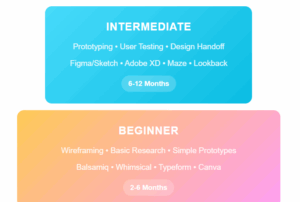
Begin by establishing clear competency milestones for different UX RESEARCH SKILLS. Create a progression framework that defines beginner, intermediate, and advanced levels for key research competencies like study design, facilitation, analysis, and communication. This framework provides concrete targets and helps you recognize when you’ve achieved meaningful growth in specific areas.
Implement a regular self-assessment practice to gauge your development. Every 30-60 days, evaluate your current UX RESEARCH SKILLS against your competency framework, noting areas of progress and identifying skills that still need attention. This systematic review prevents you from overinvesting in already-strong areas while neglecting critical development needs.
Collect objective evidence of your growing UX RESEARCH SKILLS through work samples and project outcomes. Build a portfolio that demonstrates your evolving capabilities, focusing not just on final deliverables but also on the process artifacts that showcase your thinking and methodological rigor. This documentation serves both as proof of progress and as material for reflection and improvement.
Seek regular feedback from peers, mentors, and stakeholders on specific aspects of your UX RESEARCH SKILLS. Rather than asking for general assessment, request targeted input on particular competencies you’re working to develop. This focused feedback provides actionable insights for improvement rather than vague encouragement or criticism.
Be attentive to learning efficiency metrics—how quickly you’re developing various UX RESEARCH SKILLS relative to your investment of time and effort. If certain skills are advancing slowly despite significant focus, consider alternative learning approaches. Sometimes changing instructional methods, finding different practice opportunities, or seeking specialized guidance can overcome persistent learning barriers.
Remember that learning isn’t always linear. Some UX RESEARCH SKILLS develop in spurts followed by consolidation periods where progress seems less visible but is equally important. Recognize these natural learning rhythms and adjust your expectations and strategies accordingly.
Conclusion: Sustaining Growth in Your UX Research Journey
Mastering UX RESEARCH SKILLS is not a destination but a continuous journey of refinement and expansion. As an experienced professional, your accelerated learning approach should seamlessly transition into sustainable, long-term growth strategies that keep your research practice vibrant and relevant.
The most successful UX researchers maintain their edge by embracing a perpetual beginner’s mindset, remaining curious about new methodologies and perspectives even as they develop advanced UX RESEARCH SKILLS. This intellectual humility prevents stagnation and ensures receptiveness to emerging approaches and frameworks.
Consider establishing a personalized continuing education system that systematically exposes you to developments in UX research and adjacent fields. This might include quarterly deep dives into specific UX RESEARCH SKILLS, regular participation in professional conferences, or scheduled exploration of research publications from academic and industry sources.
Balance depth and breadth in your ongoing development of UX RESEARCH SKILLS. While specialization provides valuable expertise, maintaining awareness of the full research landscape prevents blind spots and enables you to select the most appropriate methods for each research question you encounter.
As your UX RESEARCH SKILLS mature, look for opportunities to contribute to the field through mentoring, writing, speaking, or developing new methodologies. Teaching others consolidates your own learning while advancing the profession as a whole. These contributions often lead to unexpected connections and learning opportunities that further enhance your expertise.
Remember that the ultimate measure of your UX RESEARCH SKILLS is not methodological purity but impact—how effectively your research improves products, services, and experiences for users. Keep this purpose central to your practice, and let it guide your continuing professional development.
By applying the strategies outlined in this guide, experienced professionals can dramatically accelerate their acquisition of UX RESEARCH SKILLS while building a foundation for sustained growth and impact in the field of user experience.
Frequently Asked Questions
How long does it typically take to develop proficient UX RESEARCH SKILLS?
The timeline varies significantly based on prior experience, learning intensity, and practice opportunities. Experienced professionals applying accelerated learning techniques can develop functional competence in core UX research methods within 3-6 months, while mastery of advanced skills typically requires 1-2 years of deliberate practice.
Do I need formal education to develop strong UX RESEARCH SKILLS?
While formal education can provide structured learning and credentials, many successful researchers develop their UX RESEARCH SKILLS through self-directed learning, mentorship, and practical experience. The key factors are methodological rigor, critical thinking, and extensive practice rather than specific educational credentials.
Which transferable skills most effectively accelerate learning in UX research?
Critical thinking, structured problem-solving, effective communication, data analysis, and empathetic listening tend to provide the strongest foundation for rapidly developing UX RESEARCH SKILLS. Professionals with backgrounds in psychology, anthropology, market research, journalism, and data analytics often experience the smoothest transitions.
How can I practice UX RESEARCH SKILLS without a formal UX role?
Look for opportunities to incorporate research components into your current role, volunteer for research projects in your organization, offer pro bono services to non-profits, conduct independent case studies, participate in research hackathons, or analyze products you use regularly through a UX research lens.
What are the most common pitfalls experienced professionals face when learning UX research?
Common challenges include overreliance on previous professional frameworks that may not translate perfectly to UX contexts, reluctance to embrace methodological flexibility, difficulty balancing rigor with pragmatism, and underestimating the importance of research communication skills in driving impact.
Posts recentes