
Complete Guide: Transitioning to UX Design After 40 Without a Design Background
Are you considering a career change to UX Design after turning 40? You’re not alone. Many professionals are discovering that UX Design offers an exciting and fulfilling career path that values life experience and transferable skills. Transitioning to UX Design after 40 might seem daunting at first, especially without a formal design background, but it can actually be one of the most rewarding decisions you’ll ever make.
In this comprehensive guide, I’ll walk you through everything you need to know about making this career transition successfully. From leveraging your existing skills to navigating the learning curve and building a portfolio that showcases your unique perspective, this article provides actionable insights for your journey into UX Design.

Why UX Design Is Ideal for Career Changers Over 40
Many assume that design careers are exclusively for the young or those who’ve been drawing since childhood. Nothing could be further from the truth. UX Design is fundamentally about solving human problems, which means your decades of professional and life experience provide valuable context that younger designers simply don’t have.
Transitioning to UX Design after 40 comes with distinct advantages:
- Your professional maturity helps you communicate effectively with stakeholders
- Years of navigating workplace dynamics gives you political savvy
- Your established problem-solving approaches transfer remarkably well
- Life experience helps you empathize with diverse user needs
- You likely have a network that can support your transition and lead to opportunities
According to industry data, the average age of UX designers is actually increasing, with many successful professionals entering the field in their 40s, 50s, and beyond. Companies are increasingly recognizing that diverse backgrounds and perspectives lead to better design outcomes.
Sarah, a former project manager who made the switch at 47, shares: “My years managing complex projects gave me a systems-thinking approach that younger designers often struggle to develop. Once I learned the tools and methods specific to UX Design, I found myself bringing unique value to design discussions that was directly related to my previous career and life experience.”
Assessing Your Transferable Skills for UX Design
Before diving into new skills acquisition, take inventory of what you already bring to the table. Transitioning to UX Design after 40 is not about starting from scratch—it’s about building upon your existing professional foundation. Here’s how different backgrounds can translate to UX Design strengths:
From Business/Marketing
If you come from a business background, you likely understand market dynamics, user needs, and stakeholder management—all crucial aspects of UX Design. Your ability to tie design decisions to business outcomes will make you particularly valuable.
- Research skills translate directly to user research
- Customer journey mapping experience applies to UX mapping methods
- Understanding metrics helps with measuring design success
- Presentation skills transfer to design presentations
From Technology
Those with technical backgrounds often excel at the more systematic aspects of UX Design:
- Logical thinking applies to information architecture
- Technical knowledge helps you communicate with developers
- Understanding of constraints leads to feasible design solutions
- Problem-solving skills are directly applicable to design thinking
From Education/Training
Educators and trainers often make exceptional UX designers:
- Ability to explain complex concepts clearly
- Deep understanding of how people learn and process information
- Experience with assessing needs and designing solutions
- Strong empathy and communication skills
From Healthcare
Healthcare professionals bring invaluable perspective to UX Design:
- Strong empathy for users with various needs
- Experience with complex systems and workflows
- Understanding of accessibility concerns
- Ability to work under pressure and solve critical problems
No matter your background, create a skills inventory highlighting what you already know that applies to UX Design. This will boost your confidence and provide talking points for future interviews.
The Strategic Learning Path for Late-Career Transitions
Transitioning to UX Design after 40 requires a strategic approach to learning. Rather than pursuing a multi-year degree, focus on acquiring specific skills through targeted education.
Start with Fundamentals
Begin with a structured introduction to UX principles:
- Take a comprehensive UX fundamentals course (Google’s UX Design Certificate or Interaction Design Foundation offer excellent options)
- Read foundational texts like “Don’t Make Me Think” by Steve Krug and “The Design of Everyday Things” by Don Norman
- Follow UX thought leaders on LinkedIn and Medium
- Join UX communities like the Interaction Design Foundation or local UX meetup groups
Develop Technical Skills
While you don’t need to master every design tool, proficiency in these basics is essential:
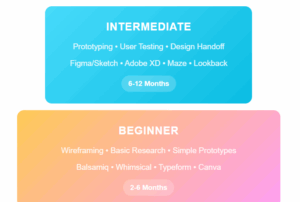
- UI Design Tools: Figma or Sketch for creating interfaces (Figma is increasingly becoming the industry standard)
- Prototyping: Learn to create interactive prototypes in Figma, Adobe XD, or ProtoPie
- Research Tools: Familiarity with tools like Optimal Workshop, UserTesting, or Lookback
- Documentation: Ability to create clear documentation in tools like Confluence or Notion
Karen, who transitioned from accounting to UX at 52, advises: “Focus on one tool and learn it well rather than trying to master everything at once. I chose Figma and became proficient enough to produce professional work, which gave me confidence to tackle other tools later.”
Build a Learning Community
Learning in isolation is challenging and inefficient. As you embark on transitioning to UX Design after 40, surround yourself with others on similar journeys:
- Find an accountability partner also learning UX Design
- Join online communities like the UX Design Slack channels or Discord servers
- Attend virtual or in-person UX meetups
- Consider joining cohort-based courses where you learn alongside peers
Create a Structured Learning Schedule
One advantage of transitioning later in life is your enhanced self-knowledge. Create a learning schedule that works with your cognitive patterns:
- Block dedicated learning time on your calendar
- Break learning into 25-45 minute focused sessions
- Create specific learning objectives for each week
- Build in review periods to consolidate knowledge
Remember that consistency trumps intensity. Thirty minutes daily will yield better results than occasional eight-hour cram sessions.

Building a Portfolio Without Previous Design Work
The most common concern when transitioning to UX Design after 40 is: “How do I build a portfolio without experience?” This challenge is very solvable with the right approach.
Start with Case Studies, Not Just Pretty Screens
A UX portfolio should demonstrate your thinking process, not just finished designs. For each project, document:
- The problem you were solving
- Your research approach
- How you generated and evaluated solutions
- Your design decisions and rationale
- The outcomes or what you learned
Create Self-Initiated Projects
Design solutions for real problems you’ve experienced or observed:
- Redesign an application you use regularly
- Create a solution for a community need
- Design a digital solution for a local business
- Reimagine a government service that’s difficult to use
Michael, who transitioned from sales management at 45, shares: “I redesigned the scheduling system for my daughter’s school activities, which was a nightmare to use. This became my strongest portfolio piece because I truly understood the problem and had deep empathy for the users.”
Volunteer Your Skills
Many organizations need UX help but lack resources:
- Offer to improve a non-profit’s website
- Join design-for-good initiatives like Catchafire or UX Rescue
- Help local businesses improve their digital presence
- Participate in UX hackathons focusing on social impact
Document Your Learning Projects
Turn course assignments into portfolio pieces by expanding on them:
- Take projects beyond the basic requirements
- Add additional research or iterations
- Document your thought process extensively
- Connect the project to real-world applications
Pro tip: Quality trumps quantity. Three deeply developed case studies demonstrating your process will impress more than ten superficial ones.
Navigating Age Bias in the Design Industry
While discussing transitioning to UX Design after 40, we must address potential age bias. The tech industry has struggled with ageism, but you can position yourself to overcome this challenge.
Emphasize Your Unique Value Proposition
Frame your age and experience as assets rather than liabilities:
- Highlight how your previous career equipped you with unique perspectives
- Demonstrate your ability to connect design decisions to business outcomes
- Showcase your professional maturity and stakeholder management skills
- Emphasize your ability to mentor younger team members
Keep Your Skills and Knowledge Current
Demonstrate that you’re up-to-date with current practices:
- Stay informed about emerging UX trends and technologies
- Participate in design challenges and hackathons
- Contribute to design discussions on platforms like Twitter/X and LinkedIn
- Share insights and articles to demonstrate your engagement with current thinking
Present Yourself as a Contemporary Professional
First impressions matter in the design world:
- Ensure your portfolio site uses contemporary design patterns
- Maintain an active, professional LinkedIn presence
- Create a modern, clean resume focused on relevant skills
- Consider creating content that showcases your thinking (articles, case studies, etc.)
James, who became a UX designer at 49 after a career in project management, notes: “I never try to hide my age—instead, I focus conversations on how my extensive experience managing complex projects helps me navigate ambiguity in the design process. This turns what some might see as a liability into my unique strength.”
Networking Strategies Specifically for Mature Career Changers
When transitioning to UX Design after 40, your existing professional network can be your greatest asset. Unlike younger designers, you’ve likely built relationships across various industries that can open doors.
Leverage Your Existing Network
- Inform your professional contacts about your career change
- Ask for introductions to designers or design managers
- Explore whether your current employer has UX opportunities
- Connect with former colleagues who work at companies with design teams
Build Design-Specific Relationships
- Attend UX conferences and meetups (both in-person and virtual)
- Participate actively in UX communities like IDF or UXPA
- Join mentorship programs like ADPList or find a mentor through networking
- Offer your domain expertise to designers in exchange for UX insights
Position Yourself as a “T-Shaped” Designer
The concept of being “T-shaped” means having deep expertise in one area (the vertical line) while having broader knowledge across multiple areas (the horizontal line). Your previous career likely gave you deep expertise that differentiates you.
For example, if you come from healthcare, you might position yourself as a UX designer with special insight into healthcare systems and patients’ needs—making you particularly valuable for health tech companies.
Create Content to Establish Credibility
Share your unique perspective through content creation:
- Write articles about UX from your unique viewpoint
- Create case studies showing how your background influences your design approach
- Share your transition journey to inspire others considering similar paths
- Contribute insights to design discussions on social media
Jennifer, who switched from HR to UX Design at 43, shares: “I started writing about designing for employee experiences, connecting my HR knowledge with UX principles. This established me as someone with unique expertise and led directly to my first UX role at an HR tech company.”
Finding Your First UX Design Role

Securing that first position is often the biggest hurdle when transitioning to UX Design after 40. Here’s how to approach the job search strategically:
Target the Right Companies
Not all companies will be equally receptive to career changers. Focus on:
- Organizations in industries where you have domain expertise
- Companies that value diverse perspectives and life experience
- Businesses undergoing digital transformation who need mature professionals
- Startups or scale-ups that need versatile team members
Consider Alternative Entry Points
Direct entry into a Senior UX Designer role may be challenging. Consider these alternative paths:
- UX Researcher roles (especially if you have research experience)
- Product Owner/Manager positions that let you collaborate with designers
- Content Strategy or Information Architecture specializations
- Internal transitions within your current company
Prepare for the Interview Process
UX interviews often include portfolio presentations, design exercises, and behavioral questions. Prepare by:
- Practicing your portfolio presentation until it’s concise and compelling
- Preparing to discuss your career transition story positively
- Doing mock interviews with experienced designers
- Researching the company’s products and design challenges thoroughly
Robert, who became a UX designer at 51 after a career in marketing, advises: “In interviews, I frame my transition as a natural evolution rather than a complete change. I show how my marketing experience helps me create designs that both delight users and meet business goals.”
Consider Contract or Freelance Work
Contract positions can be an excellent entry point:
- They often have less rigid hiring criteria
- They allow you to build professional UX experience quickly
- They lead to portfolio-worthy projects
- They can convert to full-time roles if there’s mutual interest
Continuing Growth as a Mid-Career UX Designer
Once you’ve successfully made the transition to UX Design, focus on continuous growth and specialization. As someone transitioning to UX Design after 40, you have the advantage of knowing yourself well enough to chart a fulfilling career path.
Find Your UX Specialization
While starting as a generalist is common, consider specializing based on your unique background:
- UX Research (ideal for those with research, psychology, or academic backgrounds)
- Information Architecture (great for those who excel at organizing complex information)
- UX Writing (perfect for those with communication backgrounds)
- Service Design (suitable for those who understand complex systems and organizations)
- Accessibility Design (valuable for those with healthcare or education experience)
Build a Personal Development Plan
Create a structured approach to developing your UX expertise:
- Set quarterly learning goals
- Seek regular feedback from peers and mentors
- Attend workshops and conferences to deepen specific skills
- Consider advanced certifications in your chosen specialization
Give Back Through Mentoring
As you progress, consider mentoring others:
- Offer guidance to newer career changers
- Share your unique perspective in community forums
- Create content about your specialized knowledge
- Speak at meetups or conferences about your journey
Maria, who became a UX designer at 47 after a teaching career, reflects: “Three years into my UX career, I realized my background in education gave me unique insight into designing learning experiences. I’ve now specialized in edtech UX and frequently mentor other teachers looking to make similar transitions.”
Real Success Stories: Career Changers Who Thrived in UX
Learning from those who have successfully made the journey of transitioning to UX Design after 40 can provide both inspiration and practical insights.
From Accountant to UX Designer at 52
Sarah spent 25 years in accounting before burning out. She began learning UX Design through online courses while still working full-time. Her analytical background made her exceptional at information architecture and data visualization. After completing several volunteer projects and building a portfolio, she landed a role at a fintech company that valued her financial expertise. Three years later, she leads a team designing financial tools.
Key lessons from Sarah’s journey:
- She leveraged her domain expertise rather than hiding her background
- She focused on aspects of UX Design that aligned with her analytical strengths
- She targeted companies where her financial knowledge added unique value
From Teacher to UX Researcher at 49
David taught high school for 20 years before transitioning to UX. His background in education made him particularly skilled at user interviews and synthesizing research findings. He created portfolio projects analyzing educational software, which helped him land a UX Research position at an educational technology company.
Key insights from David’s transition:
- He started with research rather than visual design, playing to his strengths
- He focused on an industry where his teaching experience was highly relevant
- He demonstrated how his classroom experience informed his understanding of users
From Healthcare Administrator to Healthcare UX Specialist at 55
Elena leveraged 25+ years in healthcare administration to become a specialized UX designer for medical software. Her deep understanding of clinical workflows and compliance requirements made her invaluable to healthcare software companies struggling with usability issues.
What made Elena’s transition successful:
- She positioned herself as a domain expert with design skills, not just a designer
- She created portfolio projects addressing real problems she’d observed in healthcare
- She networked extensively with her existing healthcare contacts to find opportunities
Practical Tips for Balancing Learning With Life Responsibilities
Video By Cottonbro Studio
One of the biggest challenges when transitioning to UX Design after 40 is balancing learning with existing life and family responsibilities. Here are practical strategies to make it work:
Create a Sustainable Learning Schedule
- Be realistic about how much time you can consistently dedicate
- Schedule shorter, frequent sessions rather than occasional marathons
- Identify your peak cognitive hours and use them for challenging material
- Create clear boundaries between learning time and family time
Involve Your Support System
- Explain your goals to friends and family so they understand your commitment
- Consider finding a study buddy in a similar life stage
- Join communities of other career changers who understand your challenges
- Celebrate milestones with your support network to maintain motivation
Make the Most of Limited Time
- Listen to UX podcasts during commutes or exercise
- Use lunch breaks for quick tutorial videos or reading
- Replace some social media time with design community participation
- Break projects into small tasks that can be completed in 30-minute windows
Thomas, who transitioned to UX at 46 while raising teenagers, shares: “I dedicated 5:30-7:00 AM to learning before the family woke up. It was hard at first, but became a cherished routine. The key was consistency—even on days when I could only manage 20 minutes.”
Frequently Asked Questions
Is it too late to learn design skills after 40?
Absolutely not. While you may approach learning differently than you did in your 20s, your life experience and professional maturity actually give you advantages in mastering UX Design, which is fundamentally about understanding human needs and solving problems.
Do I need to go back to school for a design degree?
No. While formal education is one path, many successful UX designers transition through bootcamps, online courses, and self-directed learning. Employers in UX value skills and portfolio work over credentials.
How long does it typically take to transition into UX Design?
For most career changers over 40, the transition takes 6-18 months from starting to learn to landing a first role. The timeline depends on how much time you can dedicate to learning, your existing transferable skills, and how strategically you approach the transition.
Will companies hire UX designers over 40 with no experience?
Yes, but you need to strategically position yourself. Focus on companies where your previous industry experience adds value, build a portfolio showing strong UX thinking, and emphasize how your professional maturity benefits design teams.
What’s the best first UX job to target for career changers?
Consider roles that bridge your previous experience with UX, such as UX Researcher if you have strong analytical skills, or UX Writer if you have communication experience. Also consider contract positions, which often have more flexible hiring criteria.
Conclusion: Your Experience Is Your Advantage
Transitioning to UX Design after 40 without a design background isn’t just possible—it can lead to a uniquely rewarding career that leverages your decades of professional and life experience. The journey requires dedication, strategic planning, and persistence, but the destination is worth it: meaningful work that values both creativity and the wisdom you’ve gained throughout your career.
Remember that your age and experience are not obstacles but advantages that give you unique perspective, professional maturity, and transferable skills that enhance your UX practice. The design field needs more professionals who bring diverse life experiences to the table.
What aspects of your background do you think will be most valuable in your UX career? What concerns do you have about making this transition? Share your thoughts in the comments below, and let’s continue the conversation.
This article is part of our Career Transition series. If you found it helpful, please share it with others considering similar changes.

Categorias